Exercise 5
Completion requirements
Using the differentiation rules and the derivative table, find the derivative of the function 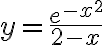
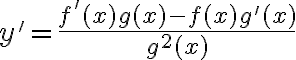
We can use the Quotient Rule. The quotient rule states that if  with
with  and
and  differentiable, then the derivative
  is given by:
-
Identify the functions

-
Calculate the derivatives of
and
- Derivative of: using the Chain Rule (we write as 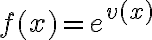 with inner function
 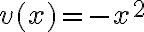 )
) 
- Derivative of
: the function is  so its derivative is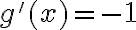
-
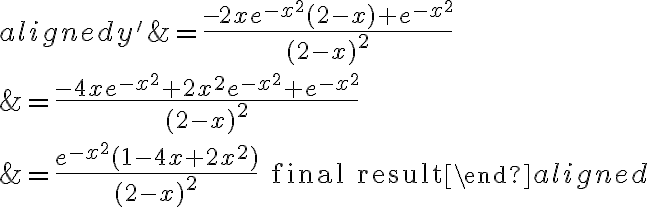
Apply the Quotient Rule
Substituting, ,  and
and  in the formula we find

-
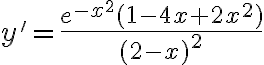
Simplify