Exercise 10
Completion requirements
Using the differentiation rules and the derivative table, find the derivative of the function 

We can use the identity 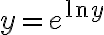 valid for every
  to rewrite the function as

Using the property of logarithms  , we get:

To calculate the derivative we can use the theorem of derivation of a composition.
-
Identify the outer function and the inner function
We write

From the Chain Rule we then get that

-
Calculate the derivative of

We use the Product Rule:
![\frac{d}{dx} [\cos x \cdot \ln (\sin x)]= \frac{d}{dx} [\cos x] \cdot \ln (\sin x) + \cos x \cdot \frac{d}{dx} [\ln (\sin x)]](https://pok.kdevs.it/filter/tex/pix.php/043e1b3a91e883b6de466c3518a137cc.gif "\frac{d}{dx} [\cos x \cdot \ln (\sin x)]= \frac{d}{dx} [\cos x] \cdot \ln (\sin x) + \cos x \cdot \frac{d}{dx} [\ln (\sin x)]")
The derivative of is
is  , so:
, so:
![\frac{d}{dx} [\cos x] \cdot \ln (\sin x) = -\sin x \cdot \ln (\sin x)](https://pok.kdevs.it/filter/tex/pix.php/1d143f94988024b443edcb22312d34b1.gif "\frac{d}{dx} [\cos x] \cdot \ln (\sin x) = -\sin x \cdot \ln (\sin x)")
The derivative of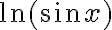 is calculated with the Chain Rule: derivative of the outer function (i.e.
  ) calculated at the inner function
  , for the derivative of :
![\frac{d}{dx} [\ln (\sin x)] = \frac{1}{\sin x} \cdot \cos x = \frac{\cos x}{\sin x}](https://pok.kdevs.it/filter/tex/pix.php/bbb229da3b660d9dcb8c0e424293c474.gif "\frac{d}{dx} [\ln (\sin x)] = \frac{1}{\sin x} \cdot \cos x = \frac{\cos x}{\sin x}")
Therefore:
![\cos x \cdot \frac{d}{dx} [\ln (\sin x)] = \frac{\cos^2x}{\sin x}](https://pok.kdevs.it/filter/tex/pix.php/aeef192c43fc8e8ae21d42507e578968.gif "\cos x \cdot \frac{d}{dx} [\ln (\sin x)] = \frac{\cos^2x}{\sin x}")
Putting the terms together:

-
Replace
and  in the Chain Rule

Remembering that  , we get the final result: