Exercise 11
Using the differentiation rules and the derivative table, find the derivative of the function 

First, we write the function without a modulus. For this it is necessary to study the sign of its argument
-
Studying the sign of the absolute value argument
Let’s start by studying the equation:

Ìt is a quadratic equation of type , so it has solutions only if the discriminant

is positive or zero. In our case ,
,  and
and  therefore

The roots of the equation are given by the formula
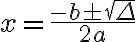
or
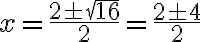
Simplifying we find:

Since , the sign of the polynomial is positive for
  and
and  , and is negative when
  and
and  , and it is negative for the internal values
  :
:

-
Function expression without absolute value

-
Calculating the derivative
-
Conclusion
We note that in  e
e  we cannot use the differentiation theorems because the analytic expression of the function is different on the left and right of each of the two values. We can instead use the rules on each open interval
- For  :
:

- For
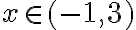 :
:
The derivative of the function  for
for  and
and  is:
is:

which we can also write compactly as
Warning!
The function is not differentiable at the points  and
and  , that is
  and
and  do not exist.
To support this statement, we use the definition of derivative: let's see how it works in the case of . Let  be our function, recalling its expression

For 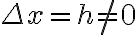 , the variation of the function is
![f(3+h)-f(3)=
\begin{cases}
(3+h)^2 - 2(3+h) - 3 & \text{if } h > 0\\
-[(3+h)^2 - 2(3+h) - 3] & \text{if } h < 0
\end{cases}](https://pok.kdevs.it/filter/tex/pix.php/0d5c2b316432c7159f21bdc4fdd2dbfe.gif "f(3+h)-f(3)=
\begin{cases}
(3+h)^2 - 2(3+h) - 3 & \text{if } h > 0\\
-[(3+h)^2 - 2(3+h) - 3] & \text{if } h < 0
\end{cases}")
Here, we are using the fact that 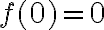 , and that is calculated as follows: for values greater than three, that is, when
  , is read from the first line, whereas when
  the input of is less than three, so we read from the second line. We can think of
  as small, since we will study the limit as approaches 0. By carrying out the calculations, we arrive at

Thus, the difference quotient of at is

Now we study the limit as approaches zero: we notice that the right-hand limit (i.e., for positive values of ) is 4. On the other hand, the left-hand limit is  .
.
This means that the limit of the difference quotient does not exist

We therefore conclude that is not differentiable at .}
With the same type of reasoning we study the case .