Derivative of the logarithm of the absolute value
Completion requirements
Let’s consider the function 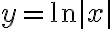 . How do we calculate its derivative?
First of all we observe that the function is defined for every real value  .
.
Let’s see what happens separately on the two sets 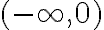 and
and 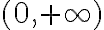 .
.
- For
 . In this case, using the definition of modulus we have
  , and the function is written as:
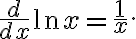
Its derivative is therefore already known from the table of derivatives, and is
- For
 . When is negative, using the definition of modulus we have
 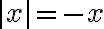 .
.
So

where is a positive number. We can then read the function as a composition

and calculate its derivative with the Chain rule:

where the term is the derivative of the external function (the logarithm on the half-line ) computed in the internal function , and the term
  is the derivative of the internal function, computed in .
Conclusion
We have found that the derivative is for both
  and
and  .
.
We can then write a unique formula for the derivative:
We have found that the derivative is
for both and . We can then write a unique formula for the derivative:

Derivative of 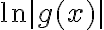
Let’s consider the function  where
where  is a given function.
Using the result just obtained we can show that, if is differentiable, the function is also differentiable, and its derivative is
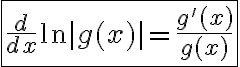
at every
such that 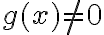 .
.In fact, by viewing the function as a composition

we can apply the Chain Rule: we thus obtain

where
is the derivative of the external function  , computed at
  , while is the derivative of the internal function , computed at .
Example
Let’s calculate the derivative of
Using the rule just seen with we have
for each value .
.
Let’s calculate the derivative of
Using the rule just seen with
we have 
for each value
.