Derivative of the composition
Completion requirements
The theorem for the derivative of a composition of two given functions can be applied iteratively to obtain the derivative of a composition of multiple functions.
For example, for the composition of three  ,
,  and
and 

denoted by
 , the following formula holds true
![[(f\circ g\circ h)]'(x)=f'(g(h(x)))\cdot g'(h(x))\cdot h'(x).](https://pok.kdevs.it/filter/tex/pix.php/0ef0e08680abc32b0336d183ca3cb5e3.gif "[(f\circ g\circ h)]'(x)=f'(g(h(x)))\cdot g'(h(x))\cdot h'(x).")
Let’s see an example of how this rule works.
Example
Let’s compute the derivative of this function

Let’s highlight the ingredients with the composition chain

We see that the innermost function,
, takes  to
to  , the second function is
 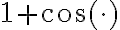 , and finally the outer function computes the natural logarithm of its input. The derivative is then obtained by multiplying three derivatives in this way:
-
the derivative of
at : 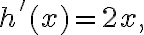
-
the derivative of
at 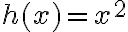 :
:
-
and finally the derivative of
calculated at  :
:
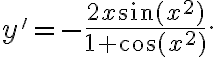
The result is therefore this

or