Derivative of the inverse
Completion requirements
Given a function  , the rule for the derivative of the inverse function allows us to calculate the numerical value of the derivative of
  at a given input even when the explicit expression of itself is not known.
Let’s see a typical example of this situation.
Example
Consider the function
is defined and differentiable at every  , and is strictly increasing (because it is the sum of two strictly increasing functions).
So it has an inverse function, which we indicate with the usual symbol, also defined on the whole .
Suppose we want to know the value of the derivative of at  . The formula for the derivative of the inverse is this:
where is the only value that satisfies
It is easy to observe that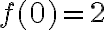 , so we deduce that
  . So we will have
We now need the derivative of, calculated at 0: using the linearity property of the derivative we have
so for we find
Now just substitute in the formula to get the result:
Consider the function

is defined and differentiable at every , and is strictly increasing (because it is the sum of two strictly increasing functions). So it has an inverse function, which we indicate with the usual symbol
, also defined on the whole . Suppose we want to know the value of the derivative of
at . The formula for the derivative of the inverse is this:![[f^{-1}]'(2)=\frac{1}{f'(a)},](https://pok.kdevs.it/filter/tex/pix.php/bb4b6f3e5540a37eba5174b7807ded69.gif "[f^{-1}]'(2)=\frac{1}{f'(a)},")
where
is the only value that satisfies 
It is easy to observe that
, so we deduce that . So we will have![(*)\qquad[f^{-1}]'(2)=\frac{1}{f'(0)}.](https://pok.kdevs.it/filter/tex/pix.php/5928381ea748dc4d7c8b314eea90dac0.gif "(*)\qquad[f^{-1}]'(2)=\frac{1}{f'(0)}.")
We now need the derivative of
, calculated at 0: using the linearity property of the derivative we have
so for
we find
Now just substitute in the formula
to get the result:![\qquad[f^{-1}]'(2)=\frac{1}{5}.](https://pok.kdevs.it/filter/tex/pix.php/9d714f5843eefe49d75d731754ad1b18.gif "\qquad[f^{-1}]'(2)=\frac{1}{5}.")