Derivative of the modulus of x
Completion requirements
The modulus (or absolute value) function of  is defined as:

To compute the derivative, consider two cases separately:
-
For
 :
:
-
For
 :
:
Conclusion
The derivative of the function  for
for  is
is
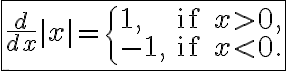
Other writings. It is possible to write the result with a single formula. For example, using the sign of
, function, which is defined just as that function that is 1 for any positive input, and -1 for negative input:
We thus have the compact formula

which can also be written like this:

The function
 is also defined in
  . How do we study the derivative in this value?
The absolute value function of is not differentiable in
To show this we must resort to the definition of derivative. Denoted by  the function
 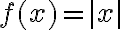 by definition is differentiable at 0 if the limit of the difference quotient of at
  ,
,
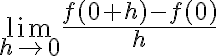
exists and is finite. Since here
 e
e 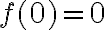 we find

So the limit from the right as
 is 1, while the limit from the left is
  . We conclude that the limit of the difference quotient does not exist: this means that f is not differentiable at .
Observation
Here is the graph of the function  : let’s see what happens from a geometric point of view.

for
 the graph is that of the line
  , while for
  it is the line
  . In
. In  , the graph has a corner point: it is not definire possible to define a tangent line to the graph at the origin.