Differentiability and continuity
Completion requirements
An intuitive but extremely important fact underlying Mathematical Analysis is that differentiable functions are always continuous:
Theorem
Let 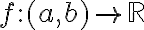 and
and 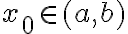 . If
. If  is differentiable at
  , then is continuous at .
and . If is differentiable at , then is continuous at .Let’s see the proof of this result together. Let’s first recall the mathematical definition of continuity: is said to be continuous at if

Proof.
Since is differentiable at . by definition this means that the limit of the difference quotient of at exists finitely:

-
Let’s show that
 tends to 0.
Recall the writing
To show that tends to 0 when  tends to 0 we reason like this: we rewrite for
  multiplying and dividing by :

therefore the two terms will have the same limit:

Since the limit of a product is the product of the limits when these exist finitely, the limit of the second term is

Since is finite, let
 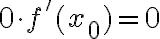 , so the limit is zero.
We have thus shown that if is differentiable at then
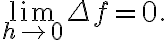
(1) -
Let’s recognize continuity.
Let’s write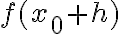 by adding and subtracting
  :
:![f(x_0+h)=f(x_0)+[f(x_0+h)-f(x_0)]=f(x_0)+\Delta f.](https://pok.kdevs.it/filter/tex/pix.php/91dd8822c0071036ca00eb494da17177.gif "f(x_0+h)=f(x_0)+[f(x_0+h)-f(x_0)]=f(x_0)+\Delta f.")
Now let’s remember that the limit of a sum is the sum of the limits, when these exist and are finite: possiamo we can therefore move to the limit by exploiting (1):

We have thus obtained that

-
Conclusion.
Setting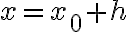 and observing that
  tends to
  if and only if h tends to tends to 0, the limit just obtained can be rewritten as
Remembering the definition of continuity, this shows that is continuous at . 
Remark
In our video lessons we have implicitly used the property (1). For example, in the reasoning of Lessons 4 and 6 that lead to understanding where the formula for the derivative of the product and the Chain Rule come from. And this is the reason why the limit of the difference quotient
In our video lessons we have implicitly used the property (1). For example, in the reasoning of Lessons 4 and 6 that lead to understanding where the formula for the derivative of the product and the Chain Rule come from. And this is the reason why the limit of the difference quotient

that defines the derivative, always presents itself in the indeterminate form  .
.