Pilot case: Mpangala farm - Part 1
The agro-pastoral farm of the Catholic University of Congo sits near Mpangala Village, about 43 km far from Kinshasa (the capital of Democratic Republic of Congo) and 9 km far from Kasangulu. The important parameters for the design of the PV system such as average global horizontal irradiance, tilt angle and 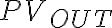 are given for the region of Kasangulu and it was concluded that the location of the farm is characterized by having:
| c1 | c2 |
|---|---|
Average Global Horizontal Irradiance ![[kW/m^2/day]](https://pok.kdevs.it/filter/tex/pix.php/a0646de788b68e69fec05893525fde22.gif "[kW/m^2/day]") |
4.846 |
| Optimum Tilt Angle of PV Modules [°] | 5 |
![PV_{OUT}[kWh/kW]](https://pok.kdevs.it/filter/tex/pix.php/b4e8c41aeccfe0b0addf8120a8aed964.gif "PV_{OUT}[kWh/kW]") |
3.868 |
![T_{avg}[°C]](https://pok.kdevs.it/filter/tex/pix.php/fbd8e0fd2ddbe796b4ea0c40a9c8e024.gif "T_{avg}[°C]") |
30 |
Different random profiles are generated considering several occupancy levels at the farm to account for variability factor in the load profile shape: it is not expected to be fully occupied throughout the whole year. For sizing purpose, the data of the worst-case scenario is considered as follows:
| c1 | c2 | |||
|---|---|---|---|---|
| Occupancy Level | Peak Power Demand ![[kW]](https://pok.kdevs.it/filter/tex/pix.php/4e9db39445ab75804f2420010831e2eb.gif "[kW]") |
Average power Demand |
Maximum daily consumption ![[kWh]](https://pok.kdevs.it/filter/tex/pix.php/7fbcd90be6c0611b22d56d0f2012d9f2.gif "[kWh]") |
Average daily consumption
|
| Full | 13.9 | 2.18 | 54.8 | 50 |
Using the above data and the attached photovoltaic (PV) panel and inverter datasheets as reference, design the PV power plant with storage to supply the farm. Consider the following electrical data and suggested steps.
| c1 | c2 |
|---|---|
| Nominal voltage of the appliances [V] | 230 |
| Assumed PV DC voltage [V] | 600 |
| Maximum discharge current [A] | 23.16 |
| Running current [A] | 3.6 |
| Days of autonomy | 6 |
| Maximum allowable depth of discharge (MDOD) | 80% |
| Design margin factor | 1.1 |
| System losses | 10% |
| Array to load value | 1.1 |
Steps
- Compute the foreseen battery capacity and adjust it using the MDOD and margin factor.
- Adjust the datasheet values coming from the PV panel considering the expected average temperature during the year.
- Adjust the maximum required production using the expected array to load value.
- Given the controller and PV panel data, calculate the foreseen daily energy production.
- Compute the minimum number of required PV modules.
- Determine the number of modules in series and of strings in parallel. Then, calculate the actual number of required PV modules.
- Now choose the most suitable power converter among those reported in the proposed datasheet, without unnecessary oversizing.