Glossary
Completion requirements
View
 GLOSSARY
- Activity
Radioactivity is the process by which an unstable atomic nucleus loses energy by radiation. A material containing unstable nuclei is considered radioactive. The total number of decays per unit time is called activity. - Atomic number Z
The atomic number or proton number (Z) is the number of protons of a nucleus. The atomic number uniquely identifies a chemical element. - Becquerel
Becquerel (Bq) is the unit of measure of activity defined by the International System of Units (SI), named in honor of the scientist Henri Becquerel. 1 Bq is defined as 1 decay per second. - Curie
Curie (Ci) is a further unit of measure of activity, not belonging to the International System of Units, but still used in some contexts, named in honor of the scientist Marie Skłodowska Curie. 1 Ci is equal to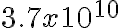 Bq and corresponds to the activity of one gram of Radium.
 - Decay constant
The decay constant (symbol: λ and unit of measure: ) of a radioactive nuclide is its probability of decay per unit time.
 - Half-life
The half-life is the time required for the number of radioactive nuclei present at the initial instant to be halved. - Isotopes
Isotopes are nuclei having same atomic number Z but different mass number A. - Mass number A
The mass number (A) is defined as the sum of the number of protons and neutrons of a nucleus.