Glossary
Completion requirements
View
 GLOSSARY
- Frequency The frequency (of a wave) is the number of complete oscillations per unit of time. Its unit of measure is hertz (Hz) (1 Hz =
- Gamma-ray
Gamma-rays are monoenergetic electromagnetic radiation (photons) emitted during the radioactive decay of atomic nuclei upon the de-excitation of atomic nuclei. Their energy ranges from few keV to few MeV. - Optical photon
Optical photons are photons which compose visible light. Their wavelength is 400 to 700 nm, which corresponds to few eV of energy. - Photon
Photons are elementary particles. They are the quanta of the electromagnetic field, i. e., the minimal entity which allows for interactions between the latter and everything else. Like any other particle, they show a dual nature, both undulatory and corpuscular, and for this reason it is possible to assign them a value of frequency and wavelength, but also energy and momentum. Photons are massless, so they always move at the speed of light in vacuum.
Basing on their wavelength, they are given different names. From longest to shortest wavelength, these are: radio waves, microwaves, infrared, visible light, ultraviolet, X-rays and gamma rays. - Photomultiplier tube
Photomultiplier tubes are devices employed in scintillation detectors to convert light into an electrical signal. - Planck constant
The Planck constant is the coefficient of proportionality between energy and frequency of a photon, its value is 6.62607004 ×
- Reaction Cross Section
Physical quantity related to the probability of occurrence of a specific nuclear reaction. It has the dimension of an area and is measured in barn (1 barn =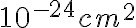 ).
).
- Scintillator
A scintillator is a kind of material able to convert the energy of impinging particles into optical photons. - Semiconductor
A semiconductor is a kind of material characterized by a crystalline structure and a very small gap between valence and conduction band. - Speed of light
The speed of light (in vacuum) is represented by the letter c and its value is 299 792 458 m/s. - Wavelength
The wavelength (of a wave) is the distance between two consecutive maxima. In the case of photons, the wavelength is related to the frequency by the following: where is the wavelength, is the speed of light and is the frequency. - X-ray
X-rays are photons emitted during the de-excitation of atomic shells. Their typical energy ranges from tens of eV to tens of keV.
 ).
).Given the dual nature of photons (both undulatory and corpuscular), it is possible to define their frequency, from which it is possible to determine their energy.