About the unstable matter
Up to today, 118 elements have been identified but each one has the possibility to have different isotopes, same element with a different amount of neutrons. We can have several allowed combinations of Z and A giving rise to more than 3300 different nuclides! The number of isotopes varies among the elements. For example, hydrogen has 7 known isotopes, C 15 and K 25. In nature there are 340 naturally occurring nuclides. Among these, only 258 have never been observed to decay: they are stable. They include 81 different elements that have one or more stable isotopes. The other unstable nuclides include radioactive primordial and naturally-occurring cosmogenic nuclides. Besides the naturally occurring nuclides, more than 3300 radionuclides have been artificially produced and studied. These nuclides are not stable, they are characterized by different half-lives. Unstable nuclides tend to reach the stable state. They are subject to radioactive decay, causing the nucleus to emit particles or electromagnetic radiation.
RADIOACTIVE DECAY MODE
The type of decay depends on how the unstable atomic nucleus loses energy and/or particles. The most common emissions are:
- alpha particles, that consist of 2 protons and 2 neutrons bonded together: a Helium nucleus;
- beta particles, high energy and high speed electrons coming from the nucleus; they could be also the so-called electron antiparticle, named positron. For the goal of this course, we can consider positrons simply as electrons with a positive charge;
- gamma and X rays, electromagnetic radiation.
The parent nuclide is the one that undergoes decay to form the daughter nuclide.
In Alpha decay, the unstable nucleus dissipates the energy by emitting an alpha particle. The atomic number Z decreases by two units and so the element decays into another nucleus. The mass number is decreased by four units (2 protons + 2 neutrons) and an alpha particle is released:
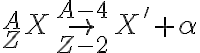
As an example let's take radon, Rn-222: its mass number is 222, by subtracting 4 you get the mass number of the daughter radionuclide, 218. Then you decrease by 2 the atomic number, you get 84... what does it correspond to? By looking at the periodic table you can identify the element, that is Polonium.

When a nucleus has too many neutrons, it is possible that one of them transforms. The neutron (without charge) emits an electron (negative), so its charge becomes positive and it turns into a proton.
In Beta minus decay, (β-) one of the neutrons in the nucleus turns into a proton, causing an increasing in the atomic number Z of the element and leading to the daughter nuclide. Consequently, the mass number does not change (protons and neutrons are both in the nucleus), but the atomic number Z increases by 1. The beta minus particle is simply a high energy electron that is emitted from the nucleus alongside with an antineutrino.



In another type of beta decay (β+) one proton is converted into a neutron. This actually decreases the atomic number of the nucleus and a positron is emitted. Positron is the antiparticle of the electron. It has the same mass as an electron and electric charge +1e.


Both electrons and positrons resulting from beta decay do not possess a fixed energy. Instead, they can be emitted according to a specific energy spectrum, which spans between zero and a maximum value, called the endpoint. The energy endpoint of beta particles is characteristic of each radioisotope.
Another type of beta decay is the electron capture, in which an orbital electron reacts with a proton in the nucleus giving a neutron and a neutrino is emitted.

There are decay modes where the nuclide does not change (Figure 1).
Some excited nuclei can persist in a so-called metastable state: this means that the isomeric transition to their ground state is appreciably slower than usual. As an example, the isomer 180mTa has a half-life of more than 1015 years! Metastability of some nuclear states is a consequence of universal conservation laws.
One is gamma decay, where the nucleus having an excess of energy emits high energy gamma rays without changing the number of protons and neutrons but just the nuclear energy level.
Alternatively, the excess of energy can be released to orbital electrons that are emitted with high energy. This decay is called internal conversion.

Figure 1 - Gamma decay and internal conversion
There are also other types of decay in which the emitted particle could be a proton, or a neutron.
During spontaneous fission a heavy unstable nucleus spontaneously splits into two (or occasionally three) smaller fragments, i.e. lighter nuclei, which in turn emit gamma rays and neutrons.
DECAY LAW
The timing of decay of an unstable nucleus is entirely random and it is impossible to predict when a particular atom will decay. It has a stochastic nature. However, it follows a specific law:

where the number of decay events -dN expected to occur in a small interval of time dt is proportional to the number of nuclides present N by a constant λ, named decay constant. The decay constant, λ, represents the probability of decay per unit of time for each individual nucleus. It quantifies the likelihood of an individual nucleus decaying per unit of time.
It is specific for each radionuclide and it is inversely proportional to its half-life t1/2, according to this relationship.
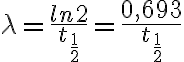
This means the shorter the half-life, the larger λ and the faster the decay.
The branching ratio in a decay process is the ratio of the number of particles which decay by a specific decay mode with respect to the total number of particles which decay by all decay modes. It can be also defined as the ratio between the partial decay constant and the overall decay constant.

Figure 2 - Decay chain of Th-232
Generally, the unstable nucleus decay leads to the formation of a radioactive daughter, still unstable.
A stable nuclide is obtained after a series of consecutive decays, called decay chain.Within the decay chain, each radionuclide has a specific decay mode and decay constant, releasing a different amount of energy. For example, as shown in the figure, Th-232 becomes Ra-228 by alpha decay with a very long half-live of 1.41∙1010 years, which in turn decays β- to Ac-228 that is still an unstable nucleus, and so on.
The number of radioactive nuclei, since they are not stable, varies with time. How can we describe the status of a radionuclide?
In the following formula, A denotes the Activity of a radionuclide:

per second. If two different samples, containing different radionuclides, have the same activity, it means that the observed disintegration rate is equal, but the number of radioactive atoms present in the sample, that is the radionuclide concentration, could be different. By integrating the activity equation, it is possible to evaluate the number of atoms present at a specific time t in function of the initial number of atoms N0.

Another quantity used in radiochemistry is the Activity concentration, indicated by CX. It is equal to the number of disintegrations per unit time and per unit mass or volume of a specific radionuclide X inside a matrix and it is given in units of Bq/kg or Bq/L:
![C_X = \frac{A}{mass} \left[\frac{Bq}{kg} \right]](https://pok.kdevs.it/filter/tex/pix.php/2c1effb7c59ca23d0fa0c3ca936263ea.gif "C_X = \frac{A}{mass} \left[\frac{Bq}{kg} \right]")
![C_X = \frac{A}{volume} \left[\frac{Bq}{L} \right]](https://pok.kdevs.it/filter/tex/pix.php/92064bfae1e2c3ae9c9fa59e85e661ab.gif "C_X = \frac{A}{volume} \left[\frac{Bq}{L} \right]")
By knowing the activity of a radionuclide in a sample, it is possible to calculate the number of atoms of such radionuclide:

from which the moles as number of atoms divided for the Avogadro’s number NA:
![n[mole] = \frac{N}{N_A}](https://pok.kdevs.it/filter/tex/pix.php/0a522a33e8f7a3df2bec99273d855442.gif "n[mole] = \frac{N}{N_A}")
And, consequently, by using the molar mass M it is possible to calculate the mass of the radionuclide in the sample:
