How much fertilizer is good for plants?

Phosphorus and nitrogen, along with potassium, are three of the main nutrients necessary for plant growth and development, affecting the quality and quantity of crops. Nitrogen fuels new growth, phosphorus promotes root development and strengthens plants, potassium improves their health.
Plants, like humans, need good nutrition to grow best, but soil is rarely perfect.

Chemical fertilizers play a key role in improving soils organic matter status, particularly in nutrient-poor soils, thereby increasing food production.
However, their use has to be optimized, since they are expensive, and their extensive use could potentially damage the environment. Fertilizers should be used in quantities that maximize efficiency in food production with minimal environmental impact.
In performing a plant nutrition study, it is important to consider two factors: the ability of the soil to supply the nutrients and the ability of the roots to absorb them. Radioisotopes can be used for this purpose, as “tags” to monitor the
uptake and the use of essential nutrients by plants from soil.

Karlsruhe Nuclide Chart, © Nucleonica GmbH, 2015
For example, radioactive 32P isotope can be used to determine the phosphorus fertilizer uptake, retention and utilization. Due to its nuclear features, it is an adequate radiotracer in plant physiology and fertilization studies. 32P contains one neutron in excess than the stable isotope 31P. It is a pure β- emitter, with a half-life of 14.29 days that enables to monitor the uptake of fertilizer from the roots to the leaves. During the experiment, the fertilizer containing the radiotracer is administered to the plant hydroponically or via water in the soil. The radiotracer is available as a solution of 32P-orthophosphate in diluted HCl (0.02 M), with specific activities of about 8500-9120 Ci/mmol. A proper quantity of radiotracer solution, before being administered to the plants, is suitably diluted with water. Then, the activity of the radioactive solution is measured (Afertilizer). The experiment is performed by injecting the traced solution into the soil at various positions and at different depths. Then, the radioactivity in the plant samples is measured, and the root activity at various positions is tested.
The effectiveness of the fertilizer is measured as the fraction or percentage of a particular nutrient derived from an applied isotopically labelled fertilizer (fPdF). This can be calculated by using the specific activity of the plant (aplant) and that of the fertilizer (afertilizer):
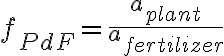
If some of the phosphorus is derived from the soil, by finding the total amount of element present in the plant and multiplying it by the previous factor, it is possible to calculate the quantity of P derived from the fertilizer [IAEA 1983].

Karlsruhe Nuclide Chart, © Nucleonica GmbH, 2015
Nitrogen is another important element of fertilizers: it is a major component of chlorophyll and also of amino acids, the building blocks of proteins. It has a number of different isotopes, but 13N is the one that is used, since it has the longest half-life of 9.97 minutes. In some cases, however, stable isotopes can be used for plant nutrition studies: one of these is 15N. Due to its more or less constant ratio to 14N in nature, it is possible to identify materials artificially enriched or depleted in 15N. Since they are not radioactive, the experiment has to be monitored over a long period of time, but their use is not a potential health hazard. The sample ratio is measured using mass spectrometers that thanks to a strong magnetic field, are able to differentially deflect ions according to their mass.
The same approach is applicable to other nutrients utilizing appropriate radioisotopes or stable isotopes.
In performing plant nutrition studies, isotopic tracers can be used to completely understand the phenomena involved and to ultimately enhance nutrient management by plants and optimize their productivity.
References
- IAEA, 1983. A Guide To The Use Of Nitrogen-15 And Radioisotopes In Studies Of Plant Nutrition: Calculations And Interpretation Of Data. IAEA-TECDOC-288.
- IAEA, 1996. Isotope studies on plant productivity. IAEA-TECDOC-889.