How many fish are in the sea?
Radiotracers can be useful in analytical chemistry for both qualitative analyses, that involve the identification of a chemical species in a sample, and quantitative analyses.
Let us suppose to have a sample containing a chemical substance to be determined. It is possible to add to the sample a known amount of the isotopically enriched substance, the radioactive tracer, and gain information about the unknown species by the dilution effect on the radiotracer. This radiotracer method is known as Isotope Dilution Analysis (IDA) and it is widely used in several applications. The basic principle consists in the fact that the specific activity of the radioactive substance changes because the radioactive isotope is diluted with the stable isotope of the same element. In these studies, the specific activity has to be determined before and after the dilution. The change in specific activity gives information on the quantity of the diluting substance. To sum up, IDA is based on the measurement of isotopic abundance of a nuclide after isotope dilution. IDA is of particular advantage for the determination of a chemical species which is difficult to separate quantitatively from a sample, such as when the system is too big. It has been developed different variants of IDA: direct isotope dilution analysis, for the determination of a non-radioactive element with
the aid of one of its radioactive isotope; reversed or inverse isotope dilution analysis, for the determination of a radioactive element with the aid of one of its stable isotope; substoichiometric isotope dilution analysis, for the determination of an element at trace level by coupling the isotope dilution with substoichiometric methods.
Isotope dilution analysis is similar to the mark and recapture method from biology, to estimate the animal population size.
How can we know how many fish there are in a lake? We take a portion of the fish, e.g. 10, we mark and then release them in the lake. After a proper “mixing” time we take another portion of the population, let’s assume 15, and we identify how many marked fish there are, 3. An estimate of the total population size can be obtained dividing the total number of marked individuals (10) by the proportion of marked individuals in the second sample (3/15). In the lake we have 50 fish!
In direct isotope dilution analysis, the unknown mass of ordinary inactive compound X is determined by adding a solution of the same compound Y0 containing a radioactive tracer, commonly called a spike, with a known activity A0.
The specific activity is:
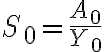
Then the solution is mixed until equilibrium.
The specific activity of the solution is changed:
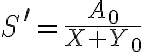
It’s time to separate a portion of this mixture, and quantify its mass Y and Activity A and specific activity:
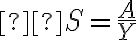
Since the specific activity remains unaltered during separation:

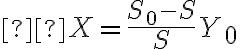
This method led George de Hevesy, who developed it in the early 20th century, to win the Nobel Prize in Chemistry.
In the reversed isotope dilution method, a radioactive analyte in a sample with known specific activity could be quantified by adding an inactive nuclide of the same element (inactive spike) and considering that the total activity of the compound remains unaltered but the specific activity decreases.